
Action
Adventure
Animation
Comedy
Crime
Documentary
Drama
Family
Fantasy
History
Horror
Music
Mystery
Romance
Science Fiction
Thriller
War
Western
Found 38 movies, 1 TV show, and 0 people
Can't find what you're looking for?
Daniela spends the summer taking care of her granny, as days go by she will unveil some family secrets...
Documentary about a group of Americans who go to Nicaragua to learn about the conflict between the Contras and the Sandinistas.

Looking for a few reasons why you should visit Nicaragua? Considering the country's two incredible coastlines, almost 20 volcanoes, lively colonial cities, abundant wildlife, rich culture, and delicious food, it won't be hard to convince you to put “visiting Nicaragua” at the top of your travel bucket list! Nicaragua, set between the Pacific Ocean and the Caribbean Sea, is a Central American nation known for its dramatic terrain of lakes, volcanoes and beaches. Vast Lake Managua and the iconic stratovolcano Momotombo sit north of the capital Managua. To its south is Granada, noted for its Spanish colonial architecture and an archipelago of navigable islets rich in tropical bird life.
A behind-the-scenes look at the making of Alex Cox's 1987 film WALKER.
Sixteen female sex workers have been named judicial aides by Nicaragua’s Supreme Court to facilitate the resolution of conflicts that come up in their work. It is the first time in the world that sex workers have had access to this function. The film accompanies some of these women in their mediation work and in the actions they promote through their association, Girasoles (Sunflowers) of Nicaragua, to gain recognition and regulations for autonomous sex work.

DREAMING NICARAGUA is a film about HOPE. It's about love for the dignity and courage of the human spirit that, even immersed in uttermost tragic conditions, fights for a better life, and in this case, with a friendly SMILE. DREAMING is a sensitive and lyrical portrayal of four children living in extreme poverty in Nicaragua. The film takes us beyond their hardships and gives voice to the youngsters, who are surprisingly funny, hopeful, and optimistic. A traveling art teacher provides a safe arena for our four unlikely protagonists to express their innermost thoughts. When painting, the kids momentarily escape the stresses of their reality into a world of dreams and ideas, a stark contrast to their lives outside: a vicious cycle of hunger, child labor, and violence. Despite the extreme circumstances, the children and their families face their lives with an inspiring unity, strength and humor.

An experimental film collectively produced in 16mm at Maumau - Recife.
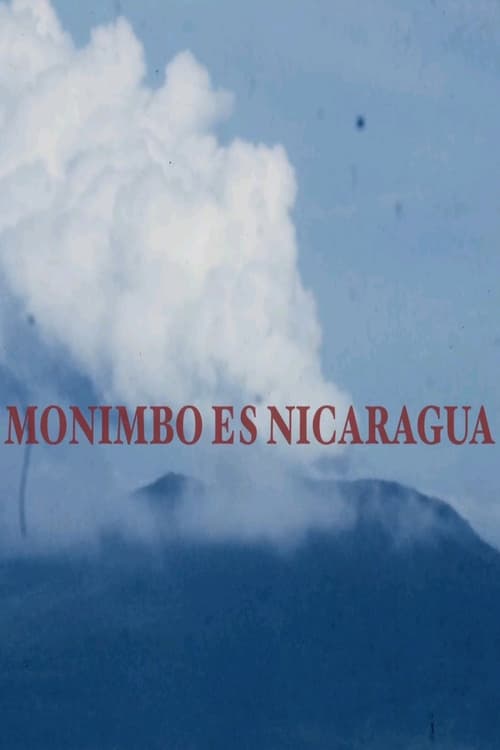
A documentary about Monimbo, a town in Nicaragua.

As the Iran-contra scandal was still unfolding, Frontline correspondent William Greider revealed how the US began supporting the contras in Nicaragua and why our involvement there continues. The program is a meticulous reconstruction of US policy toward Nicaragua, and an investigation into how US foreign policy is made.
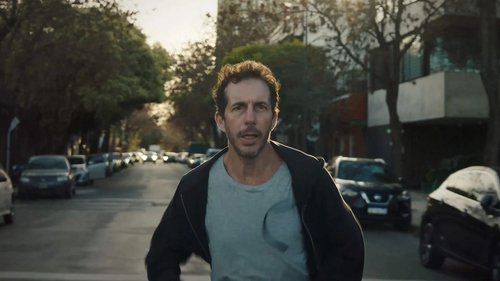
Matías's life has lost all meaning since his wife, Julia, died in a car accident. Drinking to forget has become his main occupation until he thinks he sees his deceased wife in the window of a bar. Matías decides to follow the clues that Julia seems to be sending him from the afterlife, inviting him to go with her. But every time he seems to be close to death, the signs seem to interrupt him, revealing that the message Julia wants to send is not what Matías thinks it is.
In 1978 the revolutionary Sandinista movement came to government after 43 years of organised resistance and the death of 50,000 Nicaraguans. This film follows charismatic guerilla leader Tomas Borge opposing CIA attempts to overthrow the Sandinistas.
No description available for this movie.
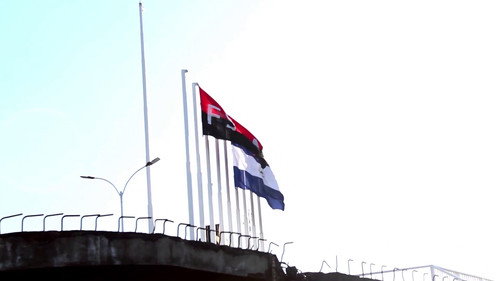
Nicaragua Against Empire highlights resistance by the people and revolutionary government of Nicaragua against Western imperialism, including sanctions and regime change efforts. It is dedicated to uplifting the voices of Nicaraguan people rarely heard in mainstream media, including workers, peasants, women and Afro-Indigenous communities.
No description available for this movie.
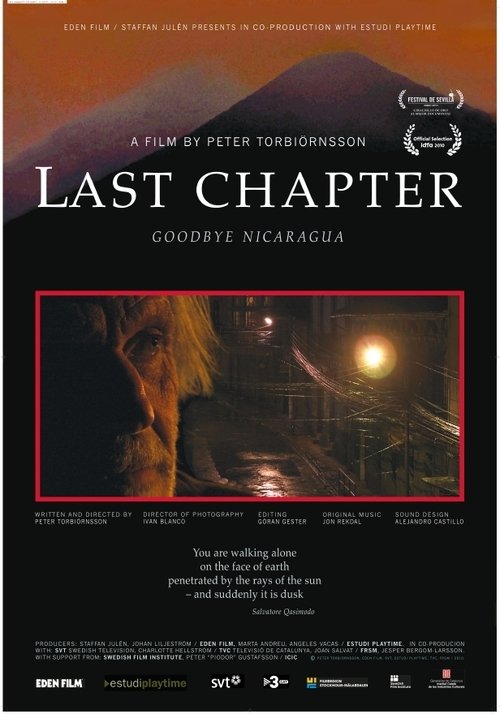
A film about guilt and blood-stained ideologies. A bomb explodes during a press conference in the jungle between Nicaragua and Costa Rica, killing more than 20 journalists. The Swedish journalist, Peter Torbiörnsson tries to discover who is behind this terrorist attack and end up discovering that his old friends are the ones who took his colleagues’ lives.
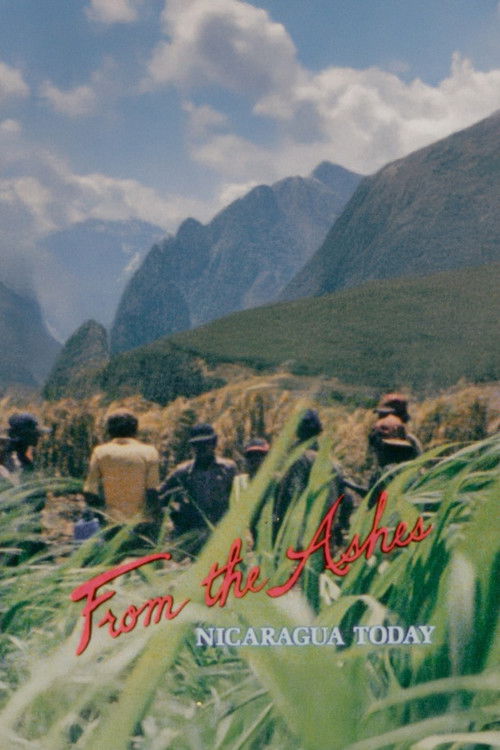
In this documentary portrait of post-revolutionary Nicaragua, director Helena Solberg follows the Chavarría family while examining the broader social and political changes following the 1979 overthrow of the Somoza dictatorship. Interweaving personal testimony with archival footage of U.S. intervention, revolutionary struggle, and national reform efforts, the film reflects on the hopes and tensions shaping the country’s future.
No description available for this movie.
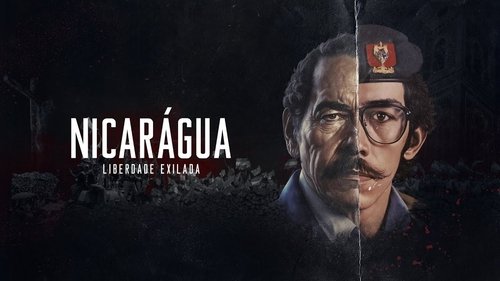
No description available for this movie.
When American documentary filmmaker Lee Shapiro witnessed the plight of the Miskito Indians under the Nicaraguan Marxist regime, he felt moved to make a film about the suffering of this brave people.
Narrated by American documentary filmmaker Emile de Antonio, this is an intimate look at a journey made by ordinary Americans to provide humanitarian aid to Nicaragua during the U.S.- sponsored contra war and economic embargo. A concerned group collected fifty tons of medical supplies from churches, human and went by ship with the supplies to Nicaragua's East Coast. Once there, they traveled to the interior, where local farmers, doctors and teachers revealed the crucial changes being made by the Sandinistas in health care, education, farming and the treatment of Miskito Indians.
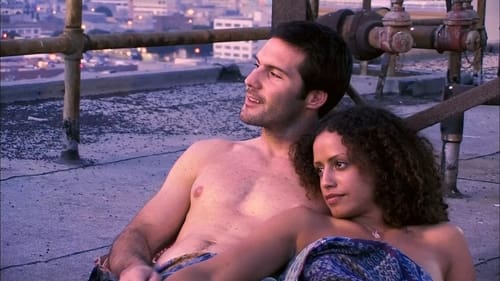
Sex, politics and American culture are mixed into a combustible combination in Now & Later. Angela is an illegal Latina immigrant living in Los Angeles who stumbles across Bill, a disgraced banker on the run. She takes him in. Through passionate sex, soul-searching conversations ranging from politics to philosophy, and other worldly pleasures, Angela introduces Bill to another worldview. As their affair heats up, the course of Bill's life begins to take an abrupt and unexpected turn.
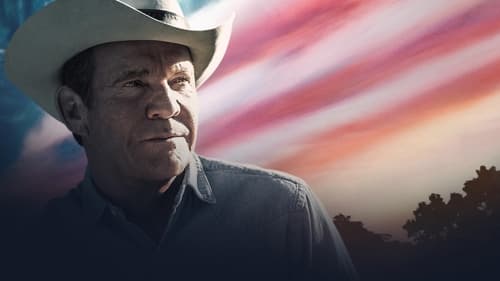
Told through the voice of former KGB agent Viktor Petrovich, whose life becomes inextricably linked with Ronald Reagan's when Reagan first caught the Soviets’ attention as an actor in Hollywood, Reagan overcomes the odds to become the 40th president of the United States.
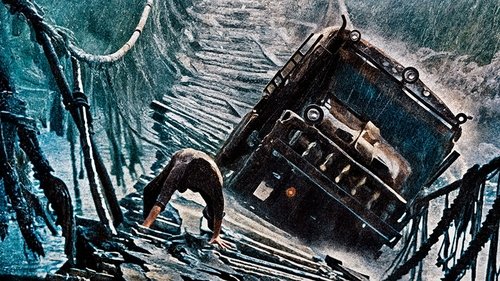
Four men from different parts of the globe, all hiding from their pasts in the same remote South American town, agree to risk their lives transporting several cases of dynamite (which is so old that it is dripping unstable nitroglycerin) across dangerous jungle terrain.

In present-day Nicaragua, a headstrong American journalist and a mysterious English businessman strike up a romance as they become embroiled in a dangerous labyrinth of lies and conspiracies and are forced to try and escape the country.

Three U.S. journalists get too close to one another and their work in 1979 Nicaragua.

William Walker and his mercenary corps enter Nicaragua in the middle of the 19th century in order to install a new government by a coup d'etat.
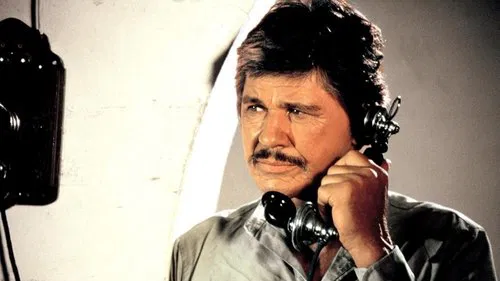
A former assassin (Charles Bronson) comes out of retirement to avenge the brutal murder of his friend at the hands of a sadistic torturer (Joseph Maher) employed by an oppressive foreign dictatorship.
A naturalistic story about the realities of healthcare and houselessness from the perspective of Ramon Duarte, a houseless welder who receives care from Miami Street Medicine, a street medicine team. In Miami, where rising housing costs are forcing folks onto the streets, the doctor's work is more important than ever.
Desperate to escape her traditional suburban life in upstate New York, a teen joins a foreign exchange program in Costa Rica in search of freedom. Instead, her world narrows under the rule of a strict host mother, until a forbidden romance with an undocumented Nicaraguan immigrant upends everything. As tensions around immigration simmer, their relationship puts both of them at risk. Caught between recklessness and self-discovery, she must decide who she wants to be — and where she belongs.
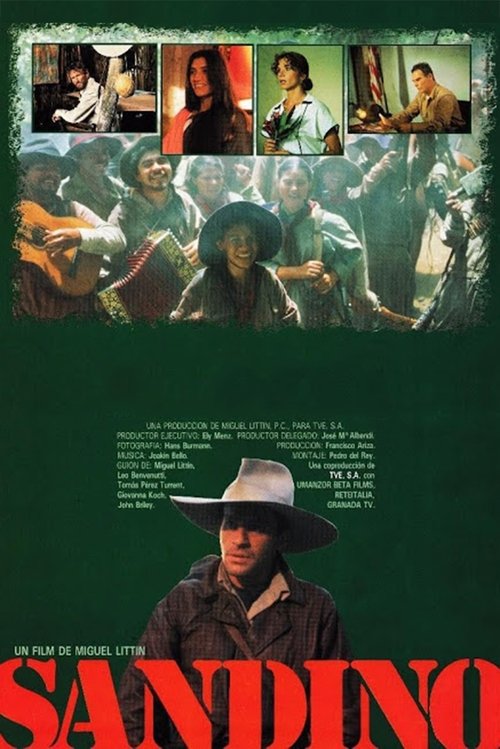
Narrative of a period of life (1926 - 1934) of the Nicaraguan revolutionary leader Sandino, who was known as "The general of free men."
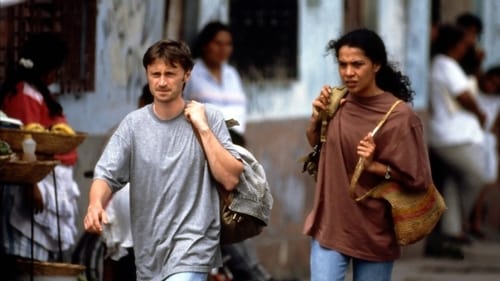
1987, love in time of war: bus driver George meets Carla, a Nicaraguan exile living a precarious, profoundly-sad life in Glasgow. Her back is scarred, her boyfriend missing, her family dispersed; she's suicidal. George takes her to Nicaragua to find out what's happened to them and help her face her past.
A moment in the life of Jacques and Kathleen, a Haitian couple confronted with the expiration of their Temporary Protected Status. Their story reflects the real fear and uncertainty thousands of families are living through right now.

Three Nicaraguan-American artists from the Washington D.C. Metro area discuss growing up in two cultures and how it influences their art.
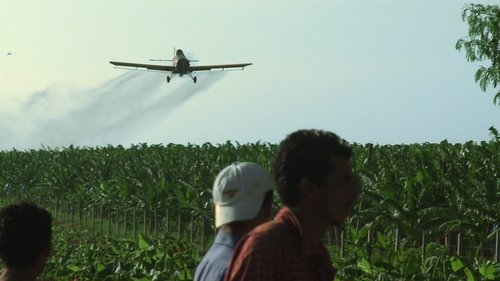
Juan “Accidentes” Dominguez is on his biggest case ever. On behalf of twelve Nicaraguan banana workers he is tackling Dole Food in a ground-breaking legal battle for their use of a banned pesticide that was known by the company to cause sterility. Can he beat the giant, or will the corporation get away with it?
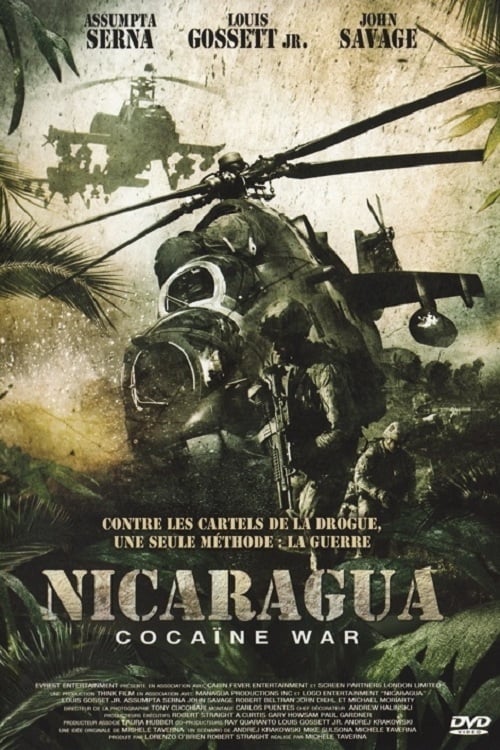
When a fellow Vietnam veteran is alleged to have thrown his lot in with the cocaine cartels, special commando Paul Gleason is dispatched to Nicaragua to sort out the mess.
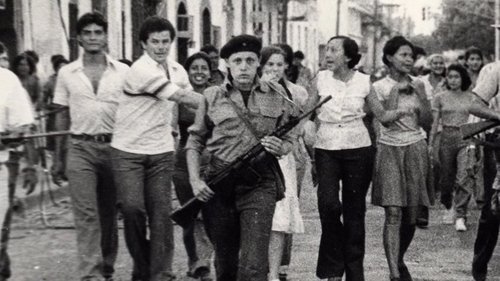
¡Las Sandinistas! uncovers the disappearing stories of women who shattered barriers to lead combat and social reform during Nicaragua’s 1979 Sandinista Revolution, and who continue to lead Nicaragua’s current struggle for democracy and equality.

An American reporter covering a civil war in Nicaragua discovers that four soldiers that he used to know during World War II are there and they are actual vampires fighting their own personal war against an evil Nicaraguan general and his own personal army of vampires terrorizing the country.
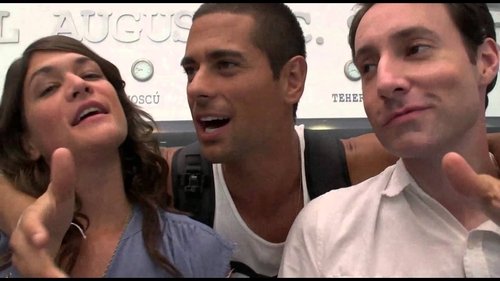
Jon and Elissa dreamed of having an epic destination wedding surrounded by their best friends. But their trip to paradise turns into an outrageous drunken weekend they wish they could forget.