
Action
Adventure
Animation
Comedy
Crime
Documentary
Drama
Family
Fantasy
History
Horror
Music
Mystery
Romance
Science Fiction
Thriller
War
Western
Found 16 movies, 2 TV shows, and 1 person
Can't find what you're looking for?

Leaving the studio to go out and capture real life: that was the impressionist aesthetic. Claude Monet was its most famous proponent and artist. This documentary reveals the places that inspired the painter during his lifetime.
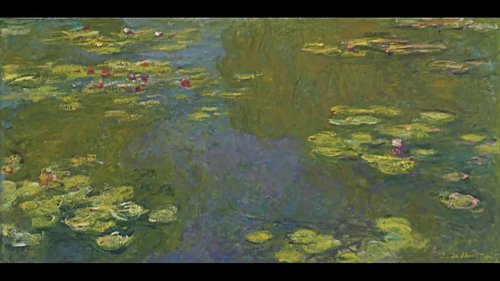
Claude Monet, alongside Auguste Renoir, is considered one of the pioneers of the impressionist movement. Inspired by the work of Turner, Monet became fixated on capturing the play of light on water. He lived in Giverny for over 40 years, painting landscapes that sought to convey a fleeting moment of nature. Monet's most famous work, the "Water Lilies Pond," exemplifies his emphasis on capturing the present moment, a reality that would change within the hour. Light plays a crucial role in his paintings, evoking an impression or emotion that is captured by the viewer's eye.

From award-winning director Phil Grabsky comes this fresh new look at arguably the world’s favourite artist – through his own words. Using letters and other private writings I, Claude Monet reveals new insight into the man who not only painted the picture that gave birth to impressionism but who was perhaps the most influential and successful painter of the 19th and early 20th centuries. Despite this, and perhaps because of it, Monet’s life is a gripping tale about a man who, behind his sun-dazzled canvases, suffered from feelings of depression, loneliness, even suicide. Then, as his art developed and his love of gardening led to the glories of his garden at Giverney, his humour, insight and love of life is revealed. Shot on location in Paris, London, Normandy and Venice I, Claude Monet is a cinematic immersion into some of the most loved and iconic scenes in Western Art.

No description available for this movie.

The work was revolutionary; it broke with the traditions of the previous generations of video artists. Thaterʼs subject matter was simple and the use of structural methods helped to articulate the medium of video projection. Thater created a jewel box with footage of Monetʼs garden broken into the primary video colors. The image was not broken apart in post-production but inside the Barco projector. Also critical to the work was Thater addressing the existing architecture of the gallery. She allowed the outside to be present and turned the window into a front and rear screen. The viewer was present, often being projected upon.
Here, Thater took three projectors, each one projecting only one color (red, green or blue) and reconstructed the image. The footage was the same as Oo Fifi Part I, but the result was an installation that accomplished its inverse. Instead of separating the projection into three component parts, Thater used three projectors to create a single composite image, thereby forming an analog approximation of a digital projection.
No description available for this movie.

Bored billionaire executive Thomas Crown entertains himself by stealing a Monet from a reputed museum with an elaborate diversion. When Catherine Banning, the insurance company's investigator, takes an interest in Crown, he may have met his match, and a complicated back-and-forth game with seductive undertones begins between them.

A journey through the masterpieces and obsessions of the Genius of the Impressionism, down the River Seine, from Le Havre to Paris and then up the river towards Argenteuil, Poissy, Vétheuil, Giverny – ending in Paris. A tour of the Museums displaying Monet's masterpieces: the Orangerie Museum, the Marmottan Museum, the Orsay Museum, ending in Monet's house and gardens at Giverny.
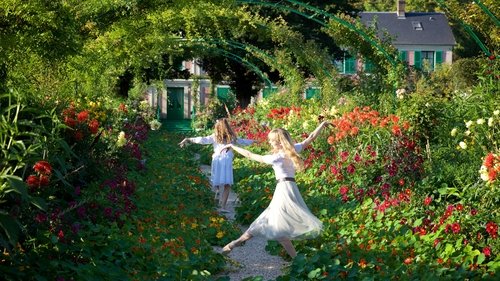
Dreams of Giverny is a modern day ghost story told through the art of classical ballet and set in the gardens of Impressionist painter Claude Monet in Giverny, France. This short tells the tale of a young woman who upon reflection at the beauty of Monet’s water lily pond, slips into a daydream where she finds herself wearing pointe shoes and able to dance exquisitely. During this reverie she encounters a ghostlike girl who guides her through the gardens, encouraging her to express her joy at the wonder of such a place through dance. By the end of their journey we are left to ponder whether this was in fact a dream or a magical ghostly encounter?

Taking its lead from French artists like Renoir and Monet, the American impressionist movement followed its own path which over a forty-year period reveals as much about America as a nation as it does about its art as a creative power-house. It’s a story closely tied to a love of gardens and a desire to preserve nature in a rapidly urbanizing nation. Travelling to studios, gardens and iconic locations throughout the United States, UK and France, this mesmerising film is a feast for the eyes. The Artist’s Garden: American Impressionism features the sell-out exhibition The Artist’s Garden: American Impressionism and the Garden Movement, 1887–1920 that began at the Pennsylvania Academy of the Fine Arts and ended at the Florence Griswold Museum, Old Lyme, Connecticut.
Monet, Cezanne, Degas, Renoir: some of the world’s most popular artists. Their works, and that of their contemporaries, fetch tens of millions of dollars around the globe. But who were they really? Why & how exactly did they paint? What lies behind their enduring appeal? To help answer these questions, this unique film secured unparalleled access to a major exhibition focussing on the man credited with inventing impressionism as we know it: 19th-century Parisian art collector Paul Durand-Ruel. This eagerly anticipated international exhibition is possibly the most comprehensive exploration of the Impressionists in history.
In 1937 the Nazi regime held two exhibitions in Munich: one to stigmatize “Degenerate Art” (which they systematically looted and destroyed) and one, personally curated by Hitler, to glorify “Classic Art”. This immersive new documentary reveals the Nazi’s complicated relationship with classical and modern art, displaying an incredible number of masterpieces by Botticelli, Klee, Matisse, Monet, Chagall, Renoir and Gauguin amongst others, intertwined with human stories from the most infamous period of the twentieth century. A state-of-the-art detective story exploring the Nazis’ obsession with creative expression, Hitler versus Picasso combines history, art and human drama for an unforgettable cinema experience.
No description available for this movie.

With family connections to some famous French artists, writers, and musicians of the time, Sacha Guitry decided to film the individuals in action, to celebrate the greatness of his culture, threatened by Germany in the ongoing Great War.
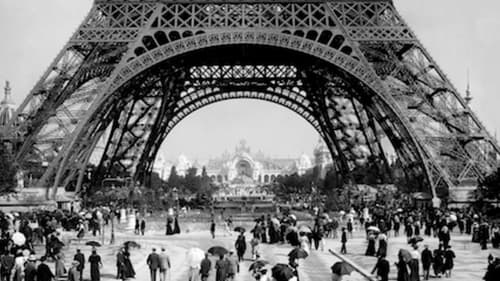
Nicole Védrès' chronicle of Paris from 1900 to 1914 is brought to life through the use of original material, all authentic, secured from more then 700 films belonging to public and private collections. A few of the celebrities of the time shown are Enrico Caruso, Sarah Bernhardt, and Maurice Chevalier.