
Action
Adventure
Animation
Comedy
Crime
Documentary
Drama
Family
Fantasy
History
Horror
Music
Mystery
Romance
Science Fiction
Thriller
War
Western
Found 20 movies, 1 TV show, and 0 people
Can't find what you're looking for?

As a boy, Raoul is reared by an Arab tribe in Algerian Sahara. Years later, as a refined Europeanized gentleman, he falls in love with Barbara, an officer's daughter, who rejects him when she discovers his background. Affecting a raid, he captures her and then secretly buys her at a slave auction. When she is rescued by French troops, however, his ancestry is established and they find happiness together.

The story of Charles de Foucauld, born September 15, 1858 in Strasbourg (France) and died December 1, 1916 in Tamanrasset in Algeria during the French colonial period, was a cavalry officer of the French army who became an explorer and geographer, then Catholic religious, priest, linguist and hermit in the Hoggar desert in Algeria.

In the Sahara, Algeria, the leader of the Tuaregs, Aftan, saves a girl from the hands of a caravan of pillars. Madeleine falls in love with her savior and their marriage is decided. But Aftan understands that he will never be assimilated with Europeans, and he goes back to find the beautiful poet Dassine whom he had loved before.
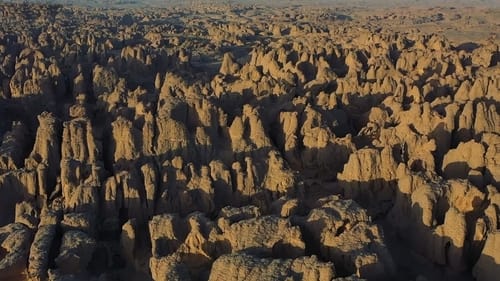
Séfar (in Arabic: سيفار) is an ancient city in the heart of the Tassili n'Ajjer mountain range in Algeria, more than 2,400 km south of Algiers and very close to the Libyan border. Séfar is the largest troglodyte city in the world, with several thousand fossilized houses. Very few travelers go there given its geographical remoteness and especially because of the difficulties of access to the site. The site is full of several paintings, some of which date back more than 12,000 years, mostly depicting animals and scenes of hunting or daily life which testify that this hostile place has not always been an inhabited desert. Local superstition suggests that the site is inhabited by djins, no doubt in connection with the strange paintings found on the site.
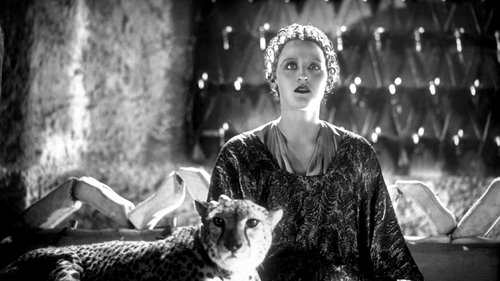
Two young officers, Saint-Avit and Morhange, get lost in the desert and find themselves prisoners of the beautiful Antinéa, queen of the city of Atlantis. Saint-Avit, blinded by his love for her, obeys her when she orders him to kill his comrade... With L’Atlantide, Pabst offers a psychoanalytic reading of Benoit’s novel, with a dominant female figure who enslaves her lovers before destroying them. The film’s fantasy dimension is disturbing, L’Atlantide bathes in a humid nightmare atmosphere, between the desperate search for a missing friend and the apparitions of an underworld lost in the desert. A long, discursive flashback suggests the Parisian origins of Antinéa, born from the marriage between Clémentine, a pretty, light-thighed French Cancan dancer, and an Arab prince seduced during a theatrical performance. But again, it's impossible to know whether these are the ramblings of an old alcoholic or the strange truth.

In the fall of 1987, Philippe Haas accompanied the sculptor Richard Long to the Algerian Sahara and filmed him tracing with his feet, or constructing with desert stones, simple geometric figures (straight lines, circles, spirals). In counterpoint to the images, Richard Long explains his approach. Since 1967, Richard Long (1945, Bristol), who belongs to the land art movement, has traveled the world on foot and installed, in places often inaccessible to the public, stones, sticks and driftwood found in situ. His ephemeral works are reproduced through photography. He thus made walking an art, and land art an aspiration of modern man for solitude in nature.

Two travelers, Boualem and Sekfali, cross the hostile and endless desert. Boualem pulls a cart on which old books, pictures, relics and memories of Sekfali are piled up. Two men, two attitudes towards life, two visions of the world. Where do they come from, where are they going? The journey would be completely calm and happy if each of them were not inhabited by their pasts, determining their different visions of the future. Boualem's childhood was marked by the Algerian war of liberation. His dream is to achieve a socialist society, which is for him the only path to salvation. Sekfali, who tries to dissuade Boualem from continuing the journey, has the attitude of an aristocrat. For him, socialism is a heresy and people do not like responsibility, they only act if a leader gives them the injunction.

The Algerian Sahara is the most exceptional deserts. He densifies everything he hosts, men and nature, and invites you to pay attention to the world. Jean-Louis and Odette Bernezat were born at the foot of the Alps, but it was in the Sahara that they found their way, and devoted almost forty years to the discovery of this environment and have extraordinary knowledge to share. Director Maryse Bergonzat accompanies them, in a meha, in the Hoggar in Algeria, with their Tuareg friends. A privileged place to appreciate the desert, its landscapes, its inhabitants, its laws and its stories, in the company of exceptional guides.

Documentary on the French Alpine expedition to Hoggar in Algeria, starring Roger Frison-Roche, Raymond Coche, Pierre Lewden, and François de Chasseloup-Laubat. The 1935 French Alpine Expedition to Hoggar was conceived and prepared by Lieutenant Raymond Coche, the ideal leader for an expedition that would combine alpine and Saharan terrain in Algeria. Among his goals, he set himself the task of leading a French rope team to the still-untouched summits of Atakor and Tefedest and planting the French flag there. His old friend, Pierre Lewden, an athlete and journalist, was soon on the team, and to complete their project and complete the trio, they called on Roger Frison-Roche, a guide from Chamonix and one of the best climbers of this generation. A few days before their departure from Paris, filmmaker Pierre Ichac joined them.
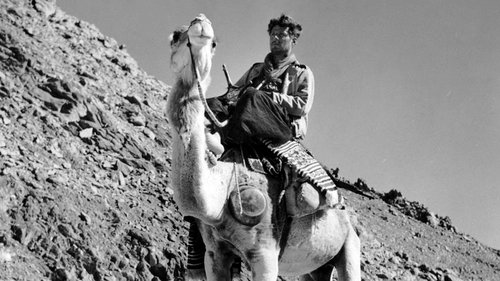
Roger Frison-Roche born in Paris in 1906 and moved to Chamonix at the age of 17. He was quickly adopted by local mountaineers and became the first guide in the Company not to have been born in the valley. He is also an insatiable explorer, in love with landscapes and peoples, having traveled from the Hoggar to the Sami camps in Lapland. And the author, among others, of the famous adventure novel Premier de Cordée! This documentary, made up of archive images and interviews, exposes the prolific life of a man who communicated his passion for the mountains by all possible means. A young journalist from Chamonix follows in the footsteps of Roger Frison-Roche. She meets people who knew him and others who followed in his footsteps: guides, filmmaker and author Philippe Claudel, a director, his family; on a trip to Lapland, Algeria, Chamonix.
No description available for this movie.

In 1950, the explorer Roger Frison-Roche made a crossing of more than a thousand kilometers on the back of a camel with the photographer Georges Tairraz II, in the heart of the Sahara, from Hoggar then Djanet in Algeria to Ghat in Libya. From their journey they brought back a large number of color films and documents. Among thousands of photos, they selected 47 images which reflect the various aspects of these immense spaces which occupy a third of Africa in the book "The Great Desert". “The Great Desert, 1000 kilometers on camelback” is the eponymous 85-minute documentary of this epic, released in 1950.

60 years ago, in the Algerian desert, an atomic bomb, equivalent to three or even four times Hiroshima, exploded. Named the “Blue Gerboise”, it was the first atomic bomb tested by France, and of hitherto unrivaled power. This 70 kiloton plutonium bomb was launched in the early morning, in the Reggane region, in southern Algeria, during the French colonial era. If this test allowed France to become the 4th nuclear power in the world, it had catastrophic repercussions. France had, at the time, certified that the radiation was well below the standard safety threshold. However, in 2013, declassified files revealed that the level of radioactivity had been much higher than announced, and had been recorded from West Africa to the south of Spain.

The Desert Rocker is an intimate, witty and profound portrait of the extraordinary Hasna El Becharia, a pioneer Gnawa artist. The first musician to break through the social barrier of this culture, she empowers and inspires women of all ages by reclaiming a musical tradition reserved for men for centuries . A singularly talented artist, she leads women to redefine their roles and challenge cultural norms , one musical performance at a time.
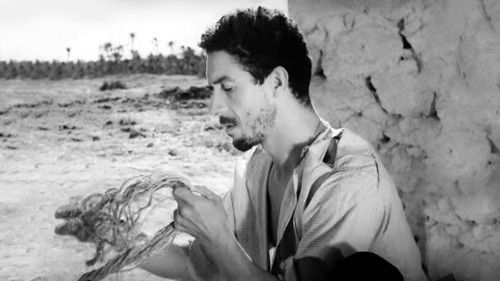
Les Plongeurs Du Désert, directed by Tahar Hannache in 1952, is considered the first entirely Algerian fiction film. It tells the story of the inhabitants of an oasis whose well has dried up. The village elder, Sheikh Messaoud, calls upon the renowned desert divers, artisans specializing in clearing sand- and silt-filled wells, to restore access to the vital water for the community. After their intervention, the water begins to flow again, bringing relief to the oasis and its inhabitants. The film depicts the contrast between the traditional techniques of the divers, embodied by Sheikh Ali and his son Mansour, and the arrival of modernity, represented by the machine that ultimately replaces their craft. This story symbolizes the marginalization of local knowledge in the face of technological progress and the social injustice of the colonial era.
Mounya doesn't like the desert, and she doesn't like Majid either, but she agreed to go with him for the weekend to southern Algeria. Rabah Bouberras directs an intimate film which tells the story of a woman taking stock of her past and present during a trip to the south of Algeria with her son and her second husband.

After reading the book "Guide to Hoggar Climbing," guide Pierre Agresti and his wife Isabelle Agresti set off into the Hoggar massif in the Algerian Sahara and tackled the west face of Garet El Djenoun. After a first attempt in 1967, they successfully reached the summit in 1970 and, with an old camera, made a film that remained unused for 25 years. In 1996, they decided to bring the past back to life through the ascent and encounters with the Tuaregs in the rock salt mines of Amadror. The film was shown in competition at the Trento Film Festival in 1997.

Thierry Damilano and his team of Tuareg guides will take you on a trek in the Algerian Sahara, to discover the local culture with a mandatory visit to the hermitage of Father de Foucauld facing Assekrem, then climbing the legendary peaks of the Hoggar massif.

The true story of explorer, journalist and writer Isabelle Eberhardt, originally from Switzerland. She moved to Annaba in Algeria in 1897 with her mother, who preferred to live in the Algerian neighborhoods rather than the European neighborhoods that she hated, and converted to Islam. Her lifestyle shocked the French colonialists: she dressed like a man, frequented cafes and smoke shops. Fascinated by the desert, she traveled the Sahara under the identity of Si Mahmoud, she published articles and books on the world she discovered in southern Algeria, strongly criticizing the colonial authorities. Arriving in El Oued, the soldiers prevent him from continuing his journey. She disobeys and overhears officers shooting Arab prisoners. Arrested, she was accused of espionage and was expelled from Algeria. She married Slimane, a Muslim non-commissioned officer in 1901. Having become French through this marriage, she could now reside in Algeria.

Shot under extreme conditions and inspired by Mayan creation theory, the film contemplates the illusion of reality and the possibility of capturing for the camera something which is not there. It is about the mirages of nature—and the nature of mirage.